
 TANAKA Hiroki
The term “Agentic Commerce” has been appearing frequently in recent years.
The concept describes a future of shopping where AI agents select and purchase products on behalf of users. There is a growing sense of urgency that businesses must hurry to adapt to this new reality.
In fact, I have gradually been receiving more questions from clients and business owners, such as “Do we need to take action?” and “Where should we start?”
If you’re an e-commerce owner asking these same questions, this article is for you.
To get straight to the conclusion: there is almost nothing entirely “new” you need to start doing to prepare for agentic commerce.
What you need to do is essentially the same as before. However, for businesses that have been putting these tasks off, the time has finally come to face them.
In this article, before you get overwhelmed by the buzzword “Agentic Commerce,” I will organize what online shop owners should know from the perspective of structural design.
Discussions on Agentic Commerce are often just about the “Pipes”
When reading articles or announcements about agentic commerce, the focus is mainly on the “mechanism of distribution.”
The UCP (Universal Commerce Protocol), introduced by Google in collaboration with Shopify and other industry partners, is a standard that connects AI agents with stores, allowing customers to give purchase-related instructions using natural language. The benefit is that users can complete payments or check order history and delivery status directly within an AI chat.
The current buzz centers on how to adapt to agentic commerce by implementing systems like UCP. These discussions are all about how to maintain the “pipes” through which products flow.
However, just listening to talk about pipes doesn’t help online shop owners see what they should do today. Furthermore, many details regarding UCP’s specifications and its rollout in Japan are still undecided. We are not yet at the stage where you need to panic and start something immediately to prepare for it.
So, what should you actually look at? What is important is the overall map of where and how agentic commerce is unfolding.
Where will the main battleground for Agentic Commerce be?
Adapting to agentic commerce does not mean supporting a single service.
AI agents search for products and sometimes handle purchases on behalf of users. The platforms supporting this mechanism are diverse and operate in different spaces. To adapt, you first need to grasp this big picture.
Once organized, you can see where to prioritize your efforts.
On the Open Internet, Google will be the leader
In the open internet accessible to everyone, Google is currently the most proactive in having AI agents find and suggest products.
OpenAI briefly offered “Instant Checkout” to complete payments within ChatGPT, but they pivoted in March 2026 to focus on product discovery features. The ACP (Agentic Commerce Protocol) framework continues, with major global players like Target, The Home Depot, and Best Buy participating.
However, even if OpenAI expands ACP in Japan, I believe Google is highly likely to be the practical protagonist of agentic commerce on the open internet. The reason is simple: Google leads others significantly in terms of search and advertising scale, as well as the maturity of its self-serve mechanisms for businesses.
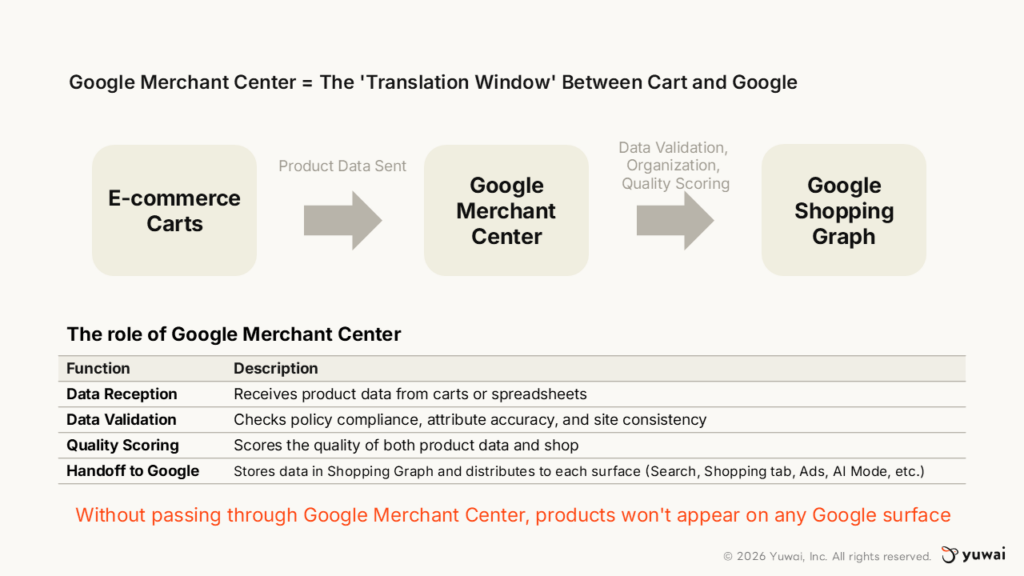
In Google’s case, product data is centralized in the Google Merchant Center and then distributed to services like Google Search, Google Maps, Gemini, and AI Overviews. To be selected by AI agents on the open internet, Google Merchant Center support is the gateway.
Amazon and Meta will operate within their own ecosystems
On the other hand, Amazon and Meta (Facebook, Instagram) are expected to deploy closed strategies within their own platforms for the time being. On Amazon, users can explore products using an AI agent called Rufus. On Meta, their respective AIs will suggest products within the advertising and shopping features of Facebook and Instagram.
These are not open systems anyone can join; they are features for businesses already listing products on those specific platforms.
Shortly after this article was published, on April 24, 2026, Amazon, Meta, Microsoft, Salesforce, and Stripe announced their participation in the Universal Commerce Protocol (UCP) Tech Council.
This means Amazon and Meta will engage with both their own closed ecosystem strategies and the open industry standard (UCP) in parallel. The industry as a whole appears to be converging on UCP. However, the core message of this article — “organizing product data into a structure that AI can correctly understand” — remains unchanged. If anything, the importance of structural data preparation will only grow as the UCP standard becomes more widely adopted.
The mechanisms differ, but the tasks are essentially the same
This is the crucial point. Whether on the open internet or within a closed ecosystem, although the data destinations differ, the essence remains the same: organizing product data into a structure that AI can correctly understand.
- For Google, deliver data to Google Merchant Center.
- For Amazon, input information into the Amazon product catalog.
- For Meta, sync the product catalog via Commerce Manager.
While specifications vary by platform, the actual work of “structuring product information and providing it in a machine-readable format for AI” is the same everywhere.
The Context of the Japanese Market: Different Battlegrounds, Same Rules
So far, we have discussed global players like Google, Amazon, and Meta. However, there is another layer in the Japanese market that cannot be ignored: the LY Corporation (LINE Yahoo) ecosystem and the Rakuten ecosystem.
Under its Connect One initiative, LY Corporation launched LINE Yahoo Ads in April 2026, integrating LINE Ads and Yahoo! JAPAN Ads. In the same month, they introduced Agent i, a new brand for AI agents. They have also begun implementing a Brand Agent concept, where AI acts as a dedicated staff member for companies to handle customer service on Official LINE Accounts. Given the massive user base of LINE and Yahoo!, they are likely to become a significant presence in Japan’s agentic commerce landscape.
Rakuten has also completed the integration of an AI concierge into the Rakuten Ichiba app as of January 2026, powered by its proprietary Japanese-focused LLM, Rakuten AI 3.0. This system provides product recommendations by analyzing data across multiple services, including Rakuten Ichiba, Rakuten Fashion, and Rakuten Rakuma. According to Rakuten’s official announcement, this has already yielded results, such as a roughly 26% increase in the average order value per user. Within the Rakuten ecosystem, shopping via agents is already becoming a reality.
A Key Realization
While LY Corporation and Rakuten are pursuing their own individual agent strategies, the essence of what they are doing is the same. In short, they are placing AI agents at the user touchpoint to suggest and sell the most suitable products based on structured product data. When it comes to the importance of structured product data, the logic is exactly the same as Google’s UCP and Google Merchant Center.
This means that whether Japanese businesses compete on LINE Yahoo, Rakuten, or Google, what is ultimately required is to organize product information into a format that AI can correctly understand. Even if specifications differ by platform, the fundamental nature of the task remains unchanged.
Looking at the status of popular ASP (Application Service Provider) carts in Japan such as MakeShop, futureshop, STORES, and Color Me Shop, support for systems equivalent to Shopify’s UCP or ACP is not yet in sight. Just as in the global market, it is likely that the speed of adaptation to the era of agentic commerce in Japan will vary depending on the cart system a business uses.
Differences in Cart System readiness
It should be noted that the speed of adaptation to agentic commerce varies greatly depending on the cart system (e-commerce platform) you use. Shopify already supports OpenAI’s ACP and Google’s UCP, serving as a hub for multiple platforms. Furthermore, Shopify’s implementation of UCP includes its own additional features, making it even more advanced than the public standard.
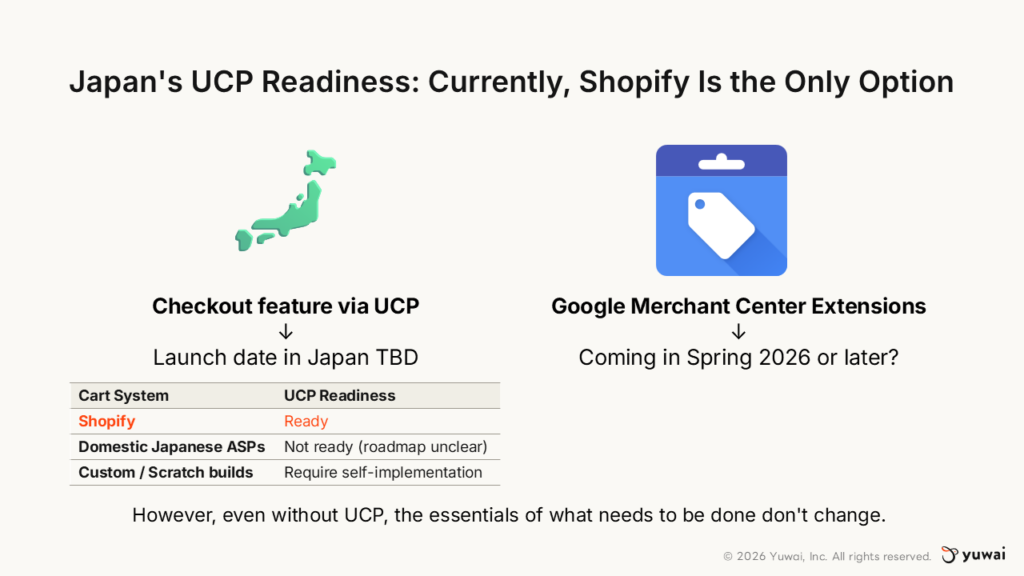
In contrast, many ASP cart systems widely used in Japan have yet to show clear signs of responding to these movements. Depending on which cart you use, the progress of preparation for the agentic commerce era may differ significantly even for the same type of business.
Google Merchant Center support is the practical answer
Looking at it this way, prioritizing Google Merchant Center support becomes an investment that ultimately lowers the cost of adapting to other platforms. The organization of product data required for Google Merchant Center (product names, categories, images, attributes, etc.) can, in most cases, be repurposed for other platforms.
If you are unsure where to start, working on Google Merchant Center is the practical answer.
The scope of actionable steps is already visible
If Google Merchant Center is the core, the scope of what a business owner can actually do is surprisingly limited.
Selection of the cart system, structural design of product data, and support for Google Merchant Center. It generally converges into these three things.
Even in discussions with clients, it eventually settles here. To be selected by an AI agent, products must be in a state where the AI can understand them correctly. To achieve that, product data must be structured and properly registered in the places Google references (Google Merchant Center → Google Shopping Graph). That is all.
There are no flashy new technologies or stories of dramatic changes based on platform choice. It is modest, cumulative work.
Agentic Commerce is an extension of Google Merchant Center, just as GEO and LLMO are extensions of SEO
To summarize everything so far in one sentence:
Agentic commerce is almost synonymous with diligently managing Google Merchant Center.
This relationship is similar to that between SEO and what is called GEO (Generative Engine Optimization) or LLMO (Large Language Model Optimization). GEO and LLMO are extensions of Search Engine Optimization (SEO), updated with the premise of being read by generative AI. They are not something entirely new; they exist on the extension of existing frameworks.
Agentic commerce is the same. The way to create product information that gets selected by AI agents is directly connected to the way you create product information for Google to understand correctly. They are not separate things.
In other words, there is no need to launch a new project called “Agentic Commerce Adaptation.” Instead, working more thoroughly than ever on the existing framework of Google Merchant Center is, in itself, the preparation for the agentic commerce era.
For businesses that haven’t taken action, the time to face it has come
The message that “there is nothing new” also means that for businesses that haven’t addressed these issues, the time to do so has arrived.
For businesses that have already maintained their Google Merchant Center, the arrival of agentic commerce is not a massive change. They can adapt as an extension of what they have been doing.
On the other hand, for businesses that have put off Google Merchant Center, the time has come to make a business decision.
There are three main options:
- Commit to it properly: Organize your cart system, align your product data, and face Google Merchant Center. It will take effort at first if you’ve delayed it, but you will be able to compete in the agentic commerce era.
- Decide not to adapt: If you don’t see a path to victory in online shopping to begin with, deciding not to invest in Google Merchant Center is a valid choice. There are still business models where physical stores or other channels are the main battleground and online is merely supplementary.
- Don’t act now, but keep it in mind: Even if you don’t have the resources to adapt immediately, you should recognize that you will gradually fall behind relatively. If there is a possibility you will work on it eventually, you will need to make a decision somewhere before the cost of catching up becomes too high.
The important thing is to choose one of these options after understanding the situation. Check how your products are displayed on Google—or if they are displayed at all. That is the starting point for judgment.
Who thinks about what when taking action?
If you decide to work on Google Merchant Center, the next question is “Who does what?”
This is not a job that can be completed by one person. It only functions when the perspectives of three roles are aligned: the Creative Director, the Engineer, and the Ad Manager. If any one of these is missing, the structure may look organized on the surface but will not actually be machine-readable for AI.
What the Creative Director considers
The director is responsible for the overall design of product information. Product naming, categorization, image policies, and the granularity of descriptions. These must be designed for human visitors and machine-readability simultaneously.
Elements that are costly to fix later, such as images or URL structures, must be implemented correctly during the initial design phase. Their role shifts from just “creating a beautiful site” to “designing a data structure that sells.”
What the Engineer considers
The engineer’s domain is how to deliver the product information designed by the director to Google Merchant Center.
This includes designing databases with feed output in mind, setting up URL structures for variations, and ensuring that prices and stock don’t desync between the cart, the site, and Google Merchant Center. It is unglamorous work, but if this link is broken, product information won’t reach Google at all. It also includes design decisions on how to supplement attributes that standard platform features cannot provide.
What the Ad Manager considers
The role of the ad manager is to continuously monitor how the product data registered in Google Merchant Center is actually displayed and where opportunities are being lost.
They identify products that aren’t showing up, products that are disapproved, or products that don’t match search terms. They feed back these issues found in the advertising field to the director and engineer to fix the structural side. It is also the ad manager’s job to communicate at the initial design stage what kind of classifications or flags would make ad management easier. Without this cycle, Google Merchant Center remains stuck at “registered and forgotten.”
It only functions when all three are present
If any of these three roles are missing, Google Merchant Center will not function to its full potential. Without the director, data won’t reach Google properly; without the engineer, what to deliver isn’t decided; and without the ad manager, the cycle of improvement isn’t born.
In small businesses, one person may play multiple roles. Even then, acting with an awareness of these three perspectives will lead to a difference in results.
Ultimately, what remains is the “Core Business”
For businesses that decide to take action, there is one more realization that comes from working on structural design.
I have explained that adapting to agentic commerce eventually converges into working on Google Merchant Center, choosing the right cart system, and organizing data.
However, even if you organize the structure, products that don’t sell won’t sell. Unfortunately.
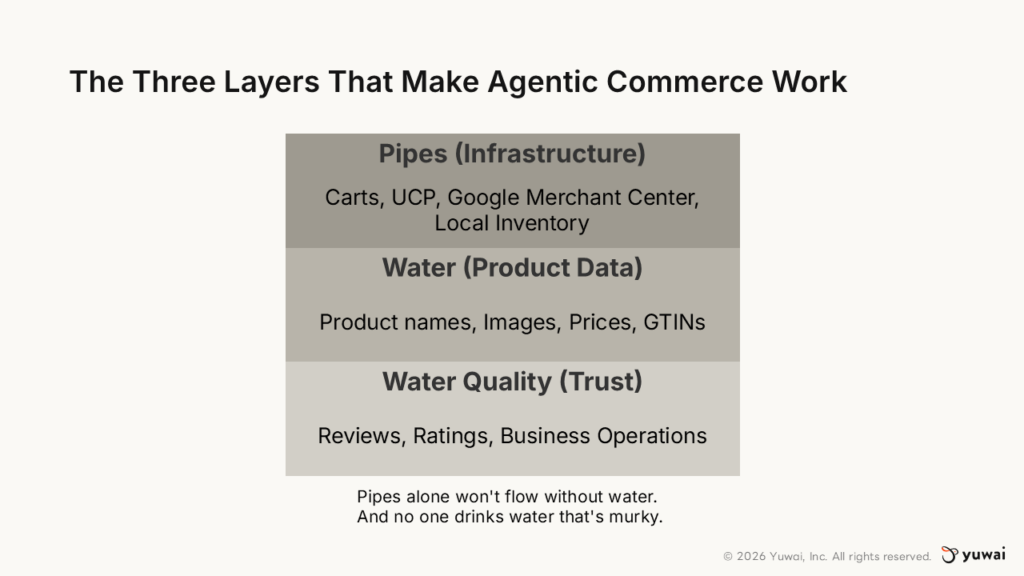
It seems obvious, but it is surprisingly overlooked. It is true that as AI agents begin to choose products, businesses with structured data will have an advantage. However, as more businesses participate, the quality of structured data will converge toward the industry average. If everyone cleans their pipes, the cleanliness of the pipes will no longer be a differentiator.
What remains then is the “water” flowing through the pipes itself—and the quality of that water. In other words, the product itself, the nature of the business behind it, and the relationship with customers (the trust built).
The AI agent era is a phase where you gain the right to participate by organizing structured data, but ultimately, the businesses with strong core commercial value will be the ones chosen.
Structural design is a necessary condition, but not a sufficient one.
Conclusion
There is no need to panic about the term “Agentic Commerce.”
What you need to do has not actually changed. Organize your cart system, organize your product data, and face Google Merchant Center. Just as GEO and LLMO are extensions of SEO, agentic commerce is an extension of Google Merchant Center.
However, for businesses that have been putting this off, this is the period where the cost of that delay will suddenly surface. It is never too late to start now.
And beyond that, what is ultimately questioned is your product itself. The structure can be organized. The data can be designed. We can help with the thinking. But the substance of the business remains a task that ultimately rests on the owner’s management decisions.
References
- Google, “New tech and tools for retailers to succeed in an agentic shopping era” — Official announcement of the Universal Commerce Protocol (UCP).
- OpenAI, “Powering Product Discovery in ChatGPT” — OpenAI’s strategic pivot from Instant Checkout to product discovery.
- Shopify Engineering, “Building the Universal Commerce Protocol” — Technical details of Shopify’s UCP implementation, including its extensions framework.
- Universal Commerce Protocol, “Amazon, Meta, Microsoft, Salesforce, and Stripe Join the Universal Commerce Protocol Tech Council” — Press release announcing the expansion of the UCP Tech Council to include additional major industry players.
- Google, “Google Merchant Center” — Official product page.
- Amazon, “Meet Rufus” — Amazon’s generative AI shopping assistant.
- Meta, “Commerce Manager Help” — Official guide for Meta’s product catalog platform.
- LY Corporation, “LINE Yahoo Ads Display Ads Launch” — Announcement of the integrated ad platform under the Connect One initiative.
- Rakuten Group, “Rakuten AI integration into Rakuten Ichiba App” — Official release on the rollout of the agentic AI tool in Rakuten’s flagship marketplace app.
- Rakuten Group, “AI Agent x Data Integration: Enhancing Customer Experience” — Source for the reported ~26% increase in average order value per user.